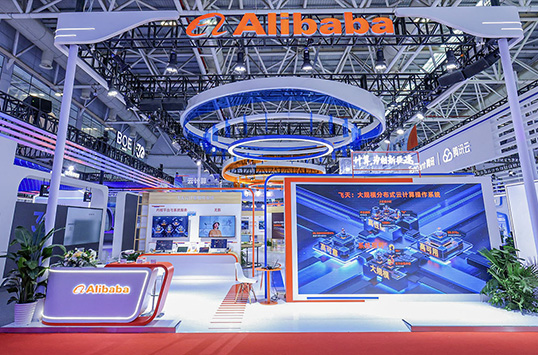



















Reporters from National Business Daily learned that on April 27, the 6th Digital China Summit opened in Fuzhou. Daniel Zhang, Chairman of the Board and CEO of Alibaba Group and CEO of Alibaba Cloud Intelligence, delivered a speech at the main forum.
Zhang stated that the construction of Digital China has yielded rich results. As a company that has always regarded digital technology as its engine for growth and source of innovation, Alibaba deeply feels how its own development is in sync with national strategy. He believes that digitization is the foundation, while intelligentization is the direction—and that today’s AI wave represents an opportunity as significant as the digitization wave two decades ago. “The industry now stands at a historic new starting point: the age of intelligentization,” he said.
In Zhang’s view, the deep integration of the new wave of artificial intelligence with the real economy will fundamentally transform every aspect of industrial practices—from production to operations. The 2G era gave rise to search engines and portals; the 3G era brought social apps; and the 4G and 5G eras triggered an explosion of video and diverse applications. Each major technological shift has spawned entirely new enterprises. “Just as the digital era produced a generation of digital-native companies, the intelligent era will inevitably give rise to a wave of AI-native enterprises. We profoundly feel that ‘everything once unimaginable will eventually become ordinary,’” he remarked.
Recently, large AI models have become a globally celebrated technological trend. In China alone, more than 200,000 enterprise users have applied to access Qwen—the large language model developed by Alibaba—for testing, spanning nearly all emerging and traditional industries. Zhang emphasized that the real economy is the main battlefield for intelligentization, and that countless industries will be redefined. “Large AI models will lower entry barriers and dramatically improve efficiency, connecting fragmented data nodes and enabling seamless data flow across R&D, production, distribution, and service,” Zhang said.
Zhang shared examples of Alibaba Cloud’s collaborations with partners such as China Southern Power Grid. “Cloud + AI” is now driving innovation in power grid operations. Matching power generation with load demand has long been a persistent industry challenge. Today, built on Alibaba’s “Apsara” cloud operating system, Alibaba provides powerful computing resources and a development/training platform. Combined with industry-specific algorithms and real-time measurement data from the grid, this solution delivers highly accurate weather forecasting and enables second-level dispatch decisions.
The widespread intelligent transformation across industries and the emergence of numerous AI-native enterprises would not be possible without high-quality, high-performance computing power. Zhang asserted: “Computing power is becoming a new type of infrastructure.”
Reporters also learned that Alibaba Cloud recently announced its largest-ever price reduction, cutting prices across core products by 15% to 50%. This move aims to continuously lower cloud adoption costs and expand the market for cloud services.
Additionally, at the Alibaba Cloud Summit on April 11, 2023, Jingren Zhou, CTO of Alibaba Cloud Intelligence, introduced the latest addition to the “Tongyi” family— the large model “Qwen.” He highlighted its capabilities in multi-turn dialogue, copywriting, logical reasoning, multimodal understanding, and multilingual support. Zhou noted that Alibaba Cloud plans to gradually integrate search and knowledge-enhancement features into the Qwen product ecosystem.